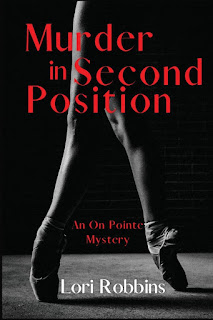
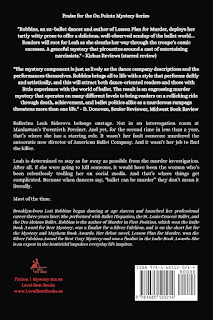
Please welcome Lori Robbins to the blog today. Her latest book is Murder in Second Position: An On Pointe Mystery. This is the second book in the series that began with Murder in First Position.
People
often ask why I’m drawn to mysteries. Aside from the fact that I love puzzles,
I think it’s because mysteries, on some level, deal with justice. This has
added resonance when the protagonist is an ordinary person, who finds himself
or herself in an extraordinary situation. That’s a setup with inherent
suspense, and it enables readers to investigate in real time with their
fictional alter-egos. But this framework poses a creative challenge of no small
proportion. The only way to credibly place a teacher, a dancer, a bookseller,
or a baker at the heart of a murder investigation is to somehow make the
impossible seem inevitable. For me, the best way to solve the problem is to
imagine myself in the protagonist’s place.
That’s
when the tough questions emerge. The first is: Would I be brave enough to
follow someone I thought might be a killer? The answer, in every case, is a
resolute no! And that’s where the fun comes in, for both the reader and
the writer. Something has to happen to make this seemingly quixotic pursuit not
only likely, but reasonable. Otherwise we’re in a situation that strains
credulity and diminishes the connection between reader and writer.
I enjoy
many stories in which an ex-cop with a tortured past and a Glock pistol fights
bad guys. Suspenseful books that feature international spies, who use the
computational skills of an MIT professor to unlock a global conspiracy, are
another favorite. And the words “Scotland Yard” are all I need to see before
going all in.
I do
rather fancy myself as a glamorous spy, dressed in designer gowns and racing
from one exotic locale or another. The truth, however, is I’ve never packed anything
more deadly than a red pen, which I use to grade English papers. Except red is
too punitive. I usually go for purple or green. Much less violent.
My
protagonists are similarly ill-equipped, both professionally and sartorially,
to deal with a deadly situation. The English teacher heroine of Lesson Plan
for Murder has, well, that red pen. And my ninety-pound, crime fighting
ballerina in the On Pointe Mystery series is armed with pair of pointe shoes.
But both women have wit and courage and plenty of determination. This is how
they find themselves, on page two hundred, doing things that would have been
impossible for them on page two.
We’re
accustomed to thinking about motivation in connection with the perpetrator and
the familiar trio of means, motive, and opportunity. But in amateur sleuth
mysteries, motivation is as important to the investigator as it is to the
killer. Chance plays an important role in moving the story and the character in
a more perilous direction, but personal choices bring to life everything that
happens after that inciting moment.
The
protagonists don’t simply learn the identity of the killer. They learn
important things about themselves. Both my heroines end up rejecting the
confines of being defined by what they do, as opposed to who they are. That’s a
challenge many are facing, now more than ever. Plenty of people have found
themselves outsourced and out of work and have to rebuild their lives in ways
they never imagined they could do. My amateur sleuth stories are pure
invention. But their lives are real.
Conflict is
central to books of any genre. It’s the thing that propels the characters out their
comfort zone and into new territory. In this chaotic world, a decisive
resolution is deeply rewarding, and when a seemingly unexceptional person has
the opportunity to provide that kind of ending, it’s a win for ordinary people
everywhere.
Really.
Lori
Robbins ©2022





 Posts
Posts

