Last week Terry
came by to talk about things research
and getting the little things right in his stories. Today he offers his
thoughts about getting the fight scenes right in his stories. The methods he outlines
below are probably better than hands on research at the malls fighting crowds
of people….
Writing
Warfare in Fiction
Epic
combat scenes are a common fare in fantasy and science fiction. Think: Armored
phalanxes armed with spears and catapults, backed by earth wizards and
flame-spewing dragons vs. necromancer-controlled zombie hordes, goblin mobs and
brutish ogres, backed by propeller-driven dive-bombers and mechanized tanks
reminiscent of WW II technology.
Okay,
maybe that combination isn’t ‘common fare’ (unless you’ve happened to stumble
across my First Civilization’s Legacy
Series). The question is: How can an author bring such battles to life for
the reader. Infuse them with excitement and, well, believability?

Personally,
I have absolutely zero military combat experience. I don’t count the several
years of U.S. Civil War reenactment, where I learned 19th Century
drills and military tactics, including the basics wielding a bayonet and saber.
I am competent in firearm safety and basic use, my experience mainly with
shotguns and revolvers. That’s it.
Add
to that, how can I convincingly write about what no author, let alone human,
has experienced? For example, an interstellar taskforce made up of carriers,
cruisers and destroyers encountering a hostile alien fleet, from large
formations down to ship to ship combat using pulse lasers, nuclear tipped
missiles, railguns, ion cannons, fusion beams, and more?
It
can be done, as proven by a multitude of authors. Admittedly, sometimes it’s accomplished
more convincingly than others. In any case, here’s what has worked for me.
The
first thing that I’ve done is a lot of reading, supplemented by watching
various programs and documentaries focusing on wars and conflicts humanity has
engaged in over the centuries. My reading includes a variety of books which, if
listed in detail, would take up several pages. Nevertheless, I’ll share four
examples in several categories:
- Books that provided ideas of overall units, weapons and tactics on a large scale:
- How to Make War by James F. Dunnigan
- The Face of Battle by John Kegan
- 50 Weapons that Changed Warfare by William Wier
- Jane’s Fighting Ships of WW II by Antony Preston
- Books that covered tactics, responses and reasoning, including personal experiences and insight from larger to smaller scale:
- The Battle of Leyte Gulf by Edwin P. Hoyt
- Citizen Soldier by Stephen E. Ambrose
- Iron Coffins by Herbert A. Werner
- Modern Air Combat: The Aircraft, Tactics and Weapons Employed in Aerial Warfare Today by Bill Gunston and Mike Spick
- Novels that included depiction/tales of combat at various levels, using a variety of technologies, including magic, and equipment:
- Red Storm Rising by Tom Clancy
- The Chronicles of Thomas Covenant the Unbeliever by Stephen R. Donaldson
- The Chronicles of Amber by Roger Zelazny
- World War Series by Harry Turtledove
There
is also the audiovisual aspect garnered from television and movies that proved
useful in supplementing the various reading material studied:
- Babylon 5
- The Lord of the Rings Trilogy
- Saving Private Ryan
- Gettysburg
I
can add that playing some strategic war games, mainly during my college years,
such as Star Fleet Battles, Panzer Leader, Kingmaker, Diplomacy, and Global
Supremacy also laid a foundation for depicting fictional strategies and
tactics.
All
of that said, I believe that #3 above is the most important and useful as it’s
directly relevant in exclusively using words to depict and provides specific
and varied ‘how to’ examples for me as an author.
Maybe
as a writer you’re feeling overwhelmed and, as a reader, thankful it’s not your
job. Really, it’s not as bad as it sounds.
Identify
the scope of what’s to be achieved when writing a battle or combat scene. I
remind myself I’m telling a story, not writing an extensive training manual or
doctrine to be studied and employed.
Identify
the POV used and focus on the knowledge and observable aspects from that
perspective. Yes, as the author, I have a wider understanding of the war,
battle or conflict, all the way down to the individual vs. individual level.
Having that allows for depth and consistency, and much of that content won’t
make the pages of the novel because it isn’t necessary to convey the story.
Think world building. An author may create an extensive world, with names and
places, culture and history, but only a fraction of it graces the pages of a
novel.


In
my Crax War Chronicles, the main
character, Security Specialist Keesay, has a far different perspective and
available knowledge than his superiors, whether he’s serving in the trench
line, fending off the advancing Crax air and armored offensive, or attempting
to survive a Crax hit-and-run landing assault, assigned to defend the research
lab deep within the Io colony, until help arrives—if it arrives.
Being
written in first person POV, the only description and events available to the
reader are those available to Specialist Keesay. But, as the writer, I’ve
already determined the Crax objectives, ships, equipment and numbers they have
available, and the tactics and backup plans they’ll use. I also have the
resources, plans and strategies Specialist Keesay’s side will employ.
From
there I just write what happens. What Keesay personally observes, is told or
witnesses through cameras, sensors or other reports. His emotions and
responses, and those of the characters around him. I keep in mind the
effectiveness of grenades, shotguns, magnetic pulse pistols and medium-duty
laser carbines, as well as the caustic pellets, molecular saws and tactics of
the armored and energy shield-protected Crax, and of their Stegmar Mantis
allies, with their CO2 powered firearms sending sprays of
toxin-coated needles.
In
addition to thoughts and actions, I include the senses. Yes, sight and sounds,
but tactile and especially smells are important in relaying the desperate
struggle to the reader.
But
how do you get it to flow? Make it real to the reader?
First,
I remember that I am telling a story, and relay sufficient action, movement,
thoughts and emotion, dialogue, and sensory description to the readers so that
they can create the action in their minds’ eye. No amount of words and
description can match the readers’ imagination.
Then
I work to pace it. Get the wording and description right. The amount of
dialogue and movement and reactions set properly for the reader to make it—the
conflict occurring—theirs.
How
do I know if I’m doing it right? Multiple revisions. I read it orally, and
share with a trusted reader. If I’m stuck or unsure, I go to the work of
another authors (category #3 above), ones who have relevant examples of
combat—similar to what I’m trying to achieve. I read and re-read those
sections, paying attention to wording and pacing and description and more.
Determine what made their scene work for me. Then I apply what I learned (or
re-learned) to my own scene and writing style, making the fictional
combat/struggle as real and believable as possible.
With
my most recent work, Thunder Wells, an apocalyptic alien
invasion novel, I counted on One Second After by William
Forstchen Alien Invasion: How to Defend Earth by Travis S. Taylor and Bob
Boan, and the Discovery Channel’s Alien Invasion: Are You Ready? If you, as a
reader, want additional insight or as a writer, more information, add them to
your list.
Terry W. Ervin II ©2016
Terry W. Ervin II is an English teacher who enjoys writing fantasy
and science fiction. Beyond his new release, Thunder Wells, his Crax War Chronicles (science fiction)
includes Relic Tech and Relic Hunted, and his First Civilization’s Legacy Series
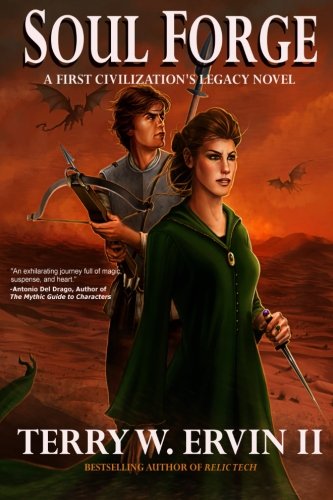
(fantasy) includes Flank Hawk, Blood Sword and Soul Forge. His short
story collection, Genre Shotgun, contains all of his stories previously published
in magazines, ezines and anthologies.


When Terry isn’t
writing or enjoying time with his wife and daughters, he can be found in his
basement raising turtles.
To contact Terry, or to
learn more about his writing endeavors, visit his website at www.ervin-author.com
and his blog, Up Around the Corner,
at uparoundthecorner.blogspot.com.






 Posts
Posts

