Showing posts with label At The Scene Of The Crime. Show all posts
Showing posts with label At The Scene Of The Crime. Show all posts
Wednesday, July 22, 2015


Thursday, May 14, 2015
Monday, May 11, 2015
Monday, November 17, 2014
Wednesday, August 20, 2014
Monday, August 04, 2014
Friday, July 18, 2014
FFB Review: "The False Inspector Dew" by Peter Lovesey --Reviewed by Patrick Ohl
Patrick Ohl is back this week for Friday's Forgotten Books. make sure you check out the list of suggested reads later today on Patti Abbott's blog. By the way, please note that Patti's books CONCRETE ANGEL and SHOT IN DETROIT have survived the shutdown of Exhibit A Books and have been picked up by Jason Pinter and Polis Books. Thrilled for Patti as well as readers everywhere......
H. H. Crippen was one of the 20th century’s most infamous murderers—or, at the very least, accused murderers. Over time, much doubt has been cast upon the “guilty” verdict, and some controversial new DNA evidence suggests that the remains found in Crippen’s basement may not have been his wife’s after all. (This evidence cannot be completely trusted, however. I’d go into details, but you’re here for a book review, not a true crime article.) Whatever the truth of the matter, Crippen and his lover, Ethel le Neve, fled to Canada, but thanks to the miracle of wireless communication, were arrested upon arrival by Inspector Walter Dew, who simply took a faster ship to get there first.
H. H. Crippen was one of the 20th century’s most infamous murderers—or, at the very least, accused murderers. Over time, much doubt has been cast upon the “guilty” verdict, and some controversial new DNA evidence suggests that the remains found in Crippen’s basement may not have been his wife’s after all. (This evidence cannot be completely trusted, however. I’d go into details, but you’re here for a book review, not a true crime article.) Whatever the truth of the matter, Crippen and his lover, Ethel le Neve, fled to Canada, but thanks to the miracle of wireless communication, were arrested upon arrival by Inspector Walter Dew, who simply took a faster ship to get there first.
It is this infamous real-life murder case
that inspires The False Inspector Dew
by Peter Lovesey. In it, a dentist named Walter Baranov decides to murder his
shrew of a wife Lydia on board the ocean liner Mauretania. The plan is a perfect one— he will be free to live with
his lover Alma, a girl absolutely devoted to him. And in a touch of irony, to
get away with the scheme he registers under a false name as Walter Dew, after
the famous inspector who caught Crippen. There’s no way the scheme could possibly fail. But, irony of ironies,
when a body is found bobbing in the ocean, the captain of the ship quite
innocently asks the eminent Inspector Dew to investigate!
An awkward situation, investigating a
murder of your own— especially when you haven’t the slightest idea how to act
like a detective! So Inspector Dew goes around talking to his fellow passengers
and discovers that he may not have been the only one up to no good during the
night…

The False Inspector Dew combines a little bit of everything—inverted mystery, comedy, and through an ingenious plot development there’s a genuine mystery to be solved as well. It’s a delightful and downright delicious book to read. The plot twists and turns throughout, making it a definite page-turner. It’s ingenious as well—Lovesey gives his readers every clue, and when you reach the ending you realise just how neatly the author has treaded the line between cheating and fair play, while always remaining firmly on the “fair play” side.
The characters are also on the good side. The
titular “False Inspector Dew” is a wonderful character; he’s a boring lover and
a bad detective who is desperately trying to pass himself off as an
ex-inspector. His lover Alma is a bit on the psychotic side, but in a very
funny way—she is the one who starts the whole romance, finding Walter’s
smallest, most ordinary gestures filled with romantic symbolism. She is a big
reader of romantic novels and has unrealistic expectations, and that makes for
plenty of fun. Even the doomed wife Lydia can be plenty of fun with her
pig-headedness over the most unreasonable requests. And then there are all the
passengers aboard the boat…
The writing is excellent and can be very
funny indeed, especially in those moments where Inspector Dew’s mask drops and
he says something he really shouldn’t have. It can also be quite suspenseful,
such as a great scene during a storm, or another scene where a killer is
apparently caught-red-handed. It’s part of the package that makes The False Inspector Dew such a treat—
and the ending is just plain perfect. It’s a really nice way to wrap everything
up for good.
Overall, I highly recommend The False Inspector Dew. It won the CWA
Gold Dagger Award, and in my opinion it was a very deserved prize. The story is
an ingenious one, with terrific plot twists throughout to easily hold your
interest. The ending is top-notch, and the reader is given every clue to solve
the mystery that crops up. The comedy is terrific. The characters are loads of
fun. And when you look at it in retrospect, there are some passages where I can
only admire the author for creating a grand puzzle-plot in the fine old
tradition. In short, the book is an absolute triumph. I highly, highly recommend it.
Patrick Ohl ©2014
Wednesday, July 16, 2014
Via At The Scene Of The Crime-- Hear Me Roar
Patrick Ohl reviews King of the Weeds by Mickey Spillane at Hear Me Roar
Monday, June 30, 2014
At The Scene Of the Crime Update--- Why I've Been So Silent Lately...
Patrick Ohl explains "Why I've Been So Silent Lately..." and I sincerely wish him all the best as he embarks on a major turning point in his life. It has been an honor and a pleasure to run his reviews here for Friday's Forgotten Books (still have a few more which is good) as well for his long distance friendship.
In the wake of what has happened to both Sandi and myself my advice is to do what feels right at the time and not count on the future. I am not the first to say the future is by no means guaranteed. I am not saying stop saving for retirement or not to do some planning. I am saying to make sure you tell folks you love them and make sure they know it. We never saw the twin freight trains coming that have barreled into our lives forever ending our plans to someday buy a home on some land so that we could have horses and travel the country. Do what you can now when every day isn't a struggle on so many fronts.
Trust me....you will be glad you did.
In the wake of what has happened to both Sandi and myself my advice is to do what feels right at the time and not count on the future. I am not the first to say the future is by no means guaranteed. I am not saying stop saving for retirement or not to do some planning. I am saying to make sure you tell folks you love them and make sure they know it. We never saw the twin freight trains coming that have barreled into our lives forever ending our plans to someday buy a home on some land so that we could have horses and travel the country. Do what you can now when every day isn't a struggle on so many fronts.
Trust me....you will be glad you did.
Friday, June 27, 2014
FFB Review: "Cop Hater" by Ed McBain --- Reviewed by Patrick Ohl
Patrick
Ohl is back today for FFB with his review of Cop Hater by Ed McBain. After you
read his review, go check out the other possibilities here.
Someone has a grudge against the police
department… more specifically, the cops at the 87th Precinct. Cops
are being gunned down left and right, apparently at random by a “cop hater”. It
is up to the cops of the 87th, already overworked and understaffed,
to avenge their fallen colleagues and bring their murderer—or is it murderers?—to
justice.
This plot device has been used many
times in mystery fiction—whether in X Vs.
Rex by Phillip Macdonald, or, more recently, Cop to Corpse by Peter Lovesey. But this time it is being used by
Ed McBain in one of his 87th Precinct police procedurals. Sergio over
at Tipping My Fedora is on a quest to
review the entire series, and his reviews are always extremely intelligent and
for the most part enthusiastic. So I decided to give McBain a chance despite my
historical dislike of the police procedural… so could McBain rise to the
challenge?

Well, yes and no. McBain is a gifted
writer and the way he describes something such as lab techniques in detail is
fascinating. In particular, I was fascinated to see how a police lab in the
1950s worked, since many of these techniques are long out of date and in some cases scientifically worthless! In the
hands of a lesser writer, these segments would come out dry and that would kill
the novel’s chance of success…
Ironically, I have no problem whatsoever
with the detailed portrait of the investigation—I liked, for instance, the way
the cops have to follow the most unlikely leads through—but I just didn’t like
many of the other elements. Basically,
I wasn’t fond of the way irrelevant passages kept cropping up. Cop Hater is a short book as is, but all
these elements come across as excessive padding nonetheless. We get long and
useless descriptions of the heat at this time of year… one of the cops
fantasizes uncomfortably about the woman he is interviewing… and so on. These
segments don’t add to character, don’t contribute much to atmosphere or story
or anything really… they’re just… there.
Enough of my whining— this book does
have some things working to its advantage. We get to know some of the cops in
detail and this helps us sympathise with all involved—although the opening slab
of dead meat is onstage so briefly that the attempt to characterize him via his
desire for an air conditioner comes across as a very poor bit of writing. But
putting that aside, since this is the first book in a series, everyone is a
potential casualty (unless you know who the main detective is going to be in
later entries). This helps to ramp things up a notch since you’re not given a
clear-cut detective to look towards.
But also, the climax is just brilliant.
It is everything a climax should be: it keeps you turning the pages in
suspense, holding your breath as you wonder how everything will turn out. It’s
a thrilling confrontation that seems like it can only end in tragedy… and I
will say no more about that.
There’s one more thing I admire a lot
about this book—although it is a police procedural, there is also an element of
genuine fair-play mystery that is so good I didn’t even realize it was there
(although I did instinctively guess at the answer). This takes pure skill— it’s
no mean feat to write a police procedural that also fulfills the requirements
of a fair-play mystery. It’s not a particularly challenging mystery—as I
said, I guessed the answer instinctively—but when you look back at the clues that
were there, it still leaves you appreciating the feat very much.
So overall, despite some excessive
padding, Cop Hater turned out to be a
wonderful and most entertaining read. I would recommend it to fellow
aficionados as a solid starting point for this series. It takes a classic plot
device and does a really nice job with it… and I will say no more out of fear
of those darned Spoiler Rapids!
Patrick Ohl ©2014
Friday, June 06, 2014
FFB Review: "The Devotion of Suspect X" by Keigo Higashino
Friday
means Friday’s Forgotten Books hosted by Patti Abbott here. She will have the
list up later today, but in the meantime Patrick Ohl is back this week with his
review of The Devotion of Suspect X
by Keigo Higashino.
In the past, I frequently complained about
the state of the modern mystery, but in recent months, I’ve discovered
wonderful authors like William L. DeAndrea and Bill Pronzini. Still, mysteries
in the classic, GAD-style mould often seem unfairly ignored— how else to
explain the lack of interest in publishing the work of Paul Halter translated
into English?
And yet, the opposite seems to be true in
Japan, where authors like Soji Shimada (author of the brilliant The Tokyo Zodiac Murders) sell well! I’m
not Japanese, nor do I understand the language, so I really cannot comment in
depth here. However, on the blog Detection by Moonlight, there recently [note:
this review was first written in 2011] was
a guest blog written by Ho-Ling, who pointed out some Japanese detective
novels (translated into English) worth checking out. After searching my library
catalogue, I managed to find one of the books Ho-Ling mentions in his final
list (which includes a disclaimer, “not a complete list”): Keigo Higashino’s The Devotion of Suspect X.

This novel is very recent—published in
Japan in 2005, and published in English in 2011. (Hey! That’s this year! That
means this book is the first “new” book I’ve reviewed on this blog!) It’s
encouraging that I was on the holds waiting list for a few weeks before I got
ahold of this book. My library also owns five copies of it—another encouraging
sign. You never know, we could see a Silver Age for mysteries someday soon…
But I digress. The Devotion of Suspect X is about Yasuko Hanaoka, a divorced
single mother. Her daughter, Misato, is a teenager attending high school and an
active part of the badminton squad. Suddenly, one night, her ex-husband shows
up at her doorstep. Things escalate and before you know it, he becomes violent
towards Misato. Alarmed, Yasuko attacks him, and with the help of her daughter,
in a desperate act of preservation, she strangles him…
Her neighbour next door is a high school
math teacher named Ishigami. The man is a genius, who wishes he could devote
his life to mathematics, but circumstances forced him to teach math to students
the school refuses to fail in the first place. He has developed an infatuation
for Yasuko and when he figures out what she has done, he devotes himself to her
cause, calculating a perfect alibi for her and her daughter in order to divert
suspicion and ensure they are not punished.

You may think I’ve given the game away, but
I assure you I have not given anything away past Chapter 2. The scenes occur
swiftly, and this book is more of an inverted murder mystery. You know who the
culprit is. You know what Ishigami has set out to do. Now, you accompany the
police inspector (Kusanagi) and the amateur sleuth (a physicist, Dr. Manabu
Yukawa) as they try piecing the puzzle together.
This book pulls the inverted mystery off brilliantly. The victim, Togashi, was a despicable man: an alcoholic, abusive, an embezzler, and a stalker who would not leave his ex-wife alone. His murder was an act of self-defense, and you feel that Yasuko should not be punished for it. And so, as the sleuths close in on the solution, you aren’t rooting for them, but for the murderer.
Meanwhile, the relationships between the
characters take on a dark twist. An old lover of Yasuko’s shows up, and this
makes Ishigami jealous. He becomes a self-appointed guardian angel who takes
his role a little too seriously. This becomes disturbing, and yet in a positive
way—the personal struggles these characters go through ring a bell. As the plan
slowly crumbles apart and Ishigami struggles to get a grip on himself, you are
genuinely disturbed for his sake and
for that of Yasuko and Misato. You see just how far his devotion will take him
and every step is utterly fascinating. In short, the characters are brilliant
and draw you into the story.
But this is not a novel mired in character
angst. On the contrary, it is the ultimate showdown between the genius amateur
sleuth and his equally admirable opponent. Every word they share may or may not
carry a double meaning behind it— they relentlessly duel with each other
throughout the novel, and every line of dialogue easily keeps your interest.
Briefly put, The Devotion of Suspect X takes the inverted mystery and gives it a
whole lot of character. The translation is excellent, and if it does the
original text any justice, Higashino’s writing is beautiful. And its ultimate
success is the intellectual duel, which is as riveting as any between Columbo
and one of his adversaries.
Patrick Ohl ©2014
At The Scene Of The Crime
Shop Amazon - Gift Ideas in Books
Thursday, June 05, 2014
Via At The Scene Of the Crime-- Top Ten Mysteries of All Time
Patrick Ohl is annoyed by the recent profusion of mystery lists and offers a few thoughts on his blog post today----Top Ten Mysteries of All Time
Friday, May 30, 2014
FFB Review: "The Dream Walker" by Charlotte Armstrong --- Guest Reviewer Patrick Ohl
Friday
means Friday’s Forgotten Books hosted by Patti Abbott here. For this final
Friday of the month of May, Patrick Ohl of the comprehensive blog “At The Scene
Of The Crime” is back. Today he reviews The
Dream Walker by Charlotte Armstrong. Lots more books over at Patti’s blog so
make sure you check out the list after reading Patrick’s review.

The
Dream Walker is about a young woman named
Olivia Hudson, a teacher at a fashionable girls’ school, aged 34. She is
narrating her story into a tape recorder as a break from looking at a
Portugal-shaped crack in her ceiling. And the tale she tells is a fantastic
one: it is the story of a plot to bring down a well-regarded man. But how do
you do that? According to Armstrong, you need a crazy plan, one so insane that
even when it is exposed it is hard to believe that someone would go to all that
trouble to fool people. Such a plot apparently took place.
The target of this plot was John Paul
Marcus, a highly respected man whose advice led to Raymond Pankerman’s illegal
activities being discovered. Now, Pankerman desires revenge, and right on cue
he met Kent Shaw, who devised a brilliant and completely mad plan to bring
about Marcus’ downfall. Four people were in on the plot, and Ollie tells us all
about it. For although the truth is now known, the damage to Marcus’ reputation
has been done, and this is Ollie’s attempt to undo it. But it’s hard work:
“Respect is a kind of Humpty Dumpty. All the King’s horses can’t put it all the
way up, again.”

The story of The Dream Walker is a fascinating one. Charlotte Armstrong shows
some plotting brilliance. From the very first chapter, you know who is in on
the plot. The plot involves an apparently-supernatural element, as a young
woman claims to walk around in places thousands of miles away in her dreams, and it really happens. Very few
variations on this impossible trick are possible, and Armstrong wisely decides
to give you the full story from the get-go. The fascination with The Dream Walker lies in how the plan is
slowly executed: the noose around Marcus’ neck slowly tightens, and I spent the
first part of the novel practically cheering on the conspiracy, eagerly waiting
to see how they would solve their difficulties. But after a certain point in
the novel, my allegiance was switched over to the other side, as I eagerly read
on to see how the plot could be defeated.
In The
Virtue of Suspense, a biography of Charlotte Armstrong by Rick Cypert, it
is observed that the novel was one of Armstrong’s responses to Joseph McCarthy’s
Communist witch-hunt. Armstrong observes that nothing is proved against
Marcus—indeed, it never could be proved because Marcus is innocent of any
wrongdoing. But all it takes is the seed of doubt for a man’s reputation to be
blown apart. A life’s work is destroyed in a matter of minutes, and the public
relishes the destruction of an idol, but doesn’t care much for its restoration.
At one point, Ollie tells the reader:

Please, if I am making this clear at
all, please do read the fine print and the follow-up and all the hard, dry
parts in the news. Don’t let your mind jump on to the next sensational
headline. Oh, it’s more fun to float along, enjoying the high spots. The new
murder. The latest scandal. Today’s clash. But afterwards, people have to live.
And if all you remember is a vague impression of some nasty mess, and the thing
that remains is only your notion that this person once fell away from the clear
and unquestioned way—and to know what truly did happen is a task too dry, too
hard—ah, please. It isn’t fair.
I found this the most powerful message
of the book, possibly due to the fact that I myself have had a personal
experience along these lines—though of course nothing as fantastical as
Armstrong’s tale. She conveys it so well that I don’t know where to start
describing her brilliance. Maybe I shouldn’t even try—this is something you
just have to experience for yourself.
The plot moves smoothly along and is a
terrific novel of suspense, quite possibly the finest I’ve read all year long.
In particular the final act is brilliant, as everything falls
apart. Mistakes occur left and right, throwing off the conspirators’ plans, and
after several misunderstandings the climax of the novel is an extremely
suspenseful and chilling confrontation.
The
Dream Walker was enthusiastically received by
critics like James Sandoe (The New York
Herald Tribune) and Anthony Boucher (The
New York Times). Sandoe is quoted as having called it “a most uncommon
thriller, quite the best Mrs. Armstrong has given us since the shattering
‘Mischief.’” I’m genuinely embarrassed that I hadn’t gotten around to Charlotte
Armstrong sooner in my reading career. I had Armstrong vaguely pegged as a
writer in the Had-I-But-Known school of Mary Roberts Rinehart. But I ask you,
can you seriously blame me for this
mistake when one of Armstrong’s books is entitled The Chocolate Cobweb?

Charlotte Armstrong has proven once
again that she could write. In my
previous read, The Case of the Weird Sisters,
Armstrong came up with a unique impossible crime and infused it with an eerie,
surreal atmosphere that fuelled my interest right up until the end. The Dream Walker contains another
impossible crime, but one to which you know the solution from the start. It is
a terrific novel of suspense and an excellent novel overall. It’s an excellent rebuttal to McCarthyism and a
fascinating look at how mere doubt can poison a man’s reputation beyond repair.
The Dream Walker is a wonderful novel
that has unequivocally placed Charlotte Armstrong among my favourite female
writers, right up there with the likes of Margaret Millar and Agatha Christie.
If you’ve never encountered Armstrong before, this makes for one hell of an introduction.
Patrick Ohl ©2014
Thursday, April 10, 2014
Via At The Scene Of The Crime--- And Then There Were Nun
Review on THE ROSARY MURDERS And Then There Were Nun
Wednesday, March 19, 2014
Patrick Ohl reviews J. M. Erre’s "Le Mystère Sherlock (The Sherlock Mystery; 2012)
Patrick Ohl reviews J. M. Erre’s Le Mystère Sherlock (The Sherlock Mystery; 2012) here at his At the Scene Of The Crime blog.
Sunday, March 09, 2014
Via Patrick Ohl-- What went wrong with SHERLOCK?
Patrick has a few thoughts about Season Three over at his "Scene of the Crime" blog. You can read it here and there are spoilers.
I don't agree with his assessment. I think the biggest problem for some folks is they don't like humor. Especially wacky humor. Season Three had more laughs in it and that hit some folks very wrong.
I don't agree with his assessment. I think the biggest problem for some folks is they don't like humor. Especially wacky humor. Season Three had more laughs in it and that hit some folks very wrong.
Friday, December 20, 2013
FFB Review: "Death on the High C’s" by Robert Barnard-- Reviewed by Patrick Ohl
Friday
means Friday’s Forgotten Books with Patti Abbott. Patti has declared today to
be in honor of Robert Barnard. The list will
be here later today. In the meantime, check out Patrick Ohl’s review of Death on the High C’s below…
There are
some books that you pick up at a bookstore on a hunch, because you just know there has to be something good in
between those covers! Maybe you’ve never heard of the author or read their
work, but you can’t resist either way. Sometimes, the hunches do not pay off— I
learned this the hard way with The Affair
at Royalties by George Baxt, purchased solely on the strength of a
brilliant cover that had absolutely no relevance to the story itself. However,
when these hunches do pay off, the
experience is extraordinary.
Such was the
case for me with Death on the High C’s
by Robert Barnard. I had heard of Barnard of course, and read his insightful
appreciation of Agatha Christie, A Talent
to Deceive, which I liked very much. So when his name appeared on a book
with such a gloriously punning title, I simply could not resist the urge to
purchase it on the spot. I do not regret this purchase in the least.

Gaylene
Ffrench fancies herself to be a great big opera star and refuses to hear
anything to the contrary. But really, her opinion is bloated— she overacts all
her parts, is nasty to her fellow cast members, and she sleeps around
indiscriminately with every available male. For once, however, she really does give a sizzling performance—in
fact, it’s downright electrifying. The problem is she doesn’t give it onstage,
but backstage… after touching the doorknob of her dressing room and stepping on
a metal doormat. The result? A jolt of electricity rushes through the
despicable young lady, and she prematurely shuffles off this mortal coil. What
makes this case particularly interesting is that several attempts have already
been made on Gaylene’s life, and it looks like the assassin has succeeded at
last.
There’s no
lack of suspects whatsoever. Everyone in the company agrees that Gaylene was a
most despicable person— not only was she arrogant and self-centered, she was
also a racist bigot. She particularly was scandalized when Calvin, a black (but
very English) member of the company gets engaged to Bridget, one of the girls
(who happens to be white and Gaylene’s unofficial rival). However, Gaylene’s
reaction may have stemmed just as much from the fact that her none-too-subtle
sexual advances on Calvin were firmly rejected. But to be honest, just about
anyone would have gladly done her in and the rest would just as gladly buy the
killer a drink as a thank-you gesture.
Enter
Superintendent Nichols, who as far as I can tell has not been reused by
Barnard. It’s a shame. He’s an intelligent man and a competent investigator,
and he has a genuinely happy, normal
marriage. It is so normal, in fact, that he barely feels the need to comment on
it! I don’t know if I’m the weird
one, but I always find it so nice when somebody has a normal, content marriage.
It’s so much more interesting than unending bouts of screaming, sarcasm, and
cruelty. There’s a lot more to Nichols than meets the eye, but to reveal more
would be to spoil a genuinely delightful plot twist.
Barnard
delights in presenting his characters and then introducing a minor twist to
them. When we first meet Calvin, he is presented as a completely ordinary
fellow, and it is only after the second chapter that Barnard remembers to
mention that he just so happens to be black. It’s the character’s greatest
strength— he isn’t black for the sake of being black, he’s just an ordinary person
who happens to be black. (Far too often, characters written expressly as black
characters end up as embarrassments, which makes Barnard’s approach so
refreshing.) While the colour of Calvin’s skin has affected him in ways he
might not want to own up to, he doesn’t let himself get bogged down by
traumatic memories.
Above all,
though, Barnard constructs a complex and fairly-clued plot in the Golden Age
tradition. He manages to plant some major clues that walked right under my nose
without being noticed. For a few clues, you’d have to know your opera to spot
the hint when it’s given, but you can still piece everything together while
being blissfully ignorant of all things opera.


You actually
want to know what happens to the characters. Unfortunately, only the central
group of characters is really strong. A fistful of characters remain
half-developed sketches because others, far more interesting, get more “screen
time”. When so-and-so suddenly reminds you of the existence of this-and-that’s
brother, it sometimes felt like a genuine shock as I struggled to remember just
when the devil that character was introduced (before eventually finding him
mentioned in the recesses of Chapter Six).
However, to
make up for this weakness is Barnard’s storytelling style, which is full of
genuine, delightful wit. This is the kind of author Gilber Adair thinks he is.
Barnard has genuine respect for the traditional form of mysteries, but he takes
delight in poking fun at some of their conventions. Here, that convention is
the person so unpleasant that nobody minds their being murdered— in fact, the
murder is treated as something of a lark… until a second murder takes place.
Even then, nobody seems to mind Gaylene’s being gone, but people do take
offense to having the second victim removed from their midst. Basically,
Barnard completely trumps Adair’s approach, but a more detailed analysis would
only result in a lot of well-deserved bile thrown in Adair’s direction.
Instead, to calm myself down, I will content myself with mentally reciting a
limerick about an old man from Khartoum.
Overall, Death on the High C’s is a witty triumph
of plotting and ingenuity, with solid characters and clueing that make the
proceedings very interesting indeed. I highly recommend the book.
Note: This review was originally written long
before Robert Barnard’s tragic death earlier this year. Looking back at the
review, I remember my delight when I first read the book and I can only wonder
at why I haven’t gotten to more of Barnard’s books yet.
Patrick Ohl is a 20-year old Canadian crime fiction aficionado who enjoys hobbies such as taxidermy and runs a dilapidated motel in the middle of nowhere alongside his crazed mother. He enjoys relaxing in his subterranean evil lair while watching his favourite hockey team, the Toronto Maple Leafs, and will occasionally make chicken chow mein to die for. His life is accompanied by a soundtrack composed by John Williams, and James Earl Jones provides occasional voice-overs.
Friday, November 29, 2013
FFB Review: "The Rising of the Moon" by Gladys Mitchell--Reviewed by Patrick Ohl
Friday means Friday’s Forgotten
Books with Patti Abbott. The list will
be here later today. In the
meantime, set the leftovers aside and put your hands together for the return of
Patrick Ohl…
Simon and
Keith Innes are two young boys who are supremely excited: the circus is coming
to town! It’s true that the festivities will be taking place on a Good Friday,
but it only comes once a year and it should be taken advantage of. And in
honour of Good Friday, the only reasonable thing to do is to sneak into the
circus without paying!
The action
begins on Holy Thursday, when the boys sneak out of their house to prepare
their route for the following night. But suddenly they see a sinister-looking
figure clutching a knife—a knife that looks rather like the knife owned by
their elder brother, with whom they live… The next day, a grisly discovery is
made—one of the circus people, a tight-rope walker, is found murdered, slashed
to death by a Jack-the-Ripper-like murderer… and the bad news is, this is only
the beginning.


The circus leaves
the town without performing, but soon enough, the villagers cower in fear
whenever the full moon is up… for it is then that the ripper strikes, killing
women and mutilating their bodies. These events are all seen through the eyes
of the two young boys—in particular, the narrator is none other than Simon, and
the story is not so much a mystery as a coming-of-age-story. The two boys are
thrown into the investigation right alongside the local police inspector and
the witch-like Mrs. Bradley, who is sent down to investigate the deaths at the
express wishes of Scotland Yard. She takes rather a liking to the boys. They
deal not only with the murderer, but must also grapple with their mathematics
assignments and they must answer a terribly important question: do Catholics
only need to go to church once a year, and if so, should they convert?
It’s a good
thing that the other elements in this book are so strong, because the mystery
is, to be frank, bloody awful. The murderer instantly became obvious to me on
page 9—and my edition of the book doesn’t start with page 1—it doesn’t even
start with page 5! But it’s not enough that the killer is obvious—oh, no… we
must also endeavour to make the ending as confusing and full of loopholes as
possible! For instance, there’s a scene where the boys finally get to see the
circus. They are told to keep an eye out for this-and-that while there, but of
course they have plenty of fun in the meantime. Then they finally spot
this-and-that, and they give the prearranged signal. What relevance does this
have to the plot? Absolutely none. It’s never referred to again, and in fact,
the ending directly contradicts the idea that this scene ever had any point whatsoever.
As for
logical loopholes, if you want to see psychology at its most gloriously
subjective, look no further than Mrs. Bradley in this book. The police start
with a perfectly reasonable notion of what kind of killer they’re looking for,
but Mrs. Bradley gives a completely different psychological profile. Who’s
right? Why, Mrs. Bradley of course, for the excellent reason that she’s the
detective and therefore can never be wrong. What made the police’s initial
assumption so unreasonable? Well, Mrs. Bradley said otherwise. What was the
significance of the moon? Well… God alone knows. At least I hope so. I wouldn’t
be surprised if God was just as puzzled over this moonshine (pun perfectly
intended).
All this
sounds as though I hate the book… but nothing could be further from the truth.
I have brought up all these problems in the book’s plot because I want to get
these over with before I reach the end of the review—I’d hate to finish on such
a severely negative note! This book is without doubt a masterpiece of writing,
but don’t set the bar high on your mystery expectations.
The book’s
best success is the writing from the POV of a child. It’s got that perfect mix
of childlike innocence and that manner many kids have of wanting to be treated
as grown-up. It all rings perfectly genuine. Simon is a wonderful character,
and we see him forced to grow up with this murder investigation. We also see
the steps he takes to avoid Sunday school and to protect his elder brother when
it seems he might be the murderer. All this is most fascinating, and the
relationship Simon has with Mrs. Bradley has a curious note of poignancy and
tenderness to it. Mrs. Bradley is just as harsh, witch-like, and cackling as
ever, but she teaches Simon a thing or two about life and she’s rather like a
mother-figure to him.
The
atmosphere meanwhile is brilliant. Just… brilliant.
The slowly increasing fear and terror of the villagers… the way the tension is
ratcheted up notch by notch… that final chase in the moonlight… everything adds
up beautifully, and it’s hard to describe the overall effect. I’m at a loss of
words.
So overall, I
tend to agree that The Rising of the Moon
is a masterpiece from the Golden Age of Detective Fiction… but you have to keep
an open mind when the conclusion rolls around, because it is among the most
ridiculous, plot-hole-ridden endings in detective fiction. It’s up to you to
decide how you will take the ending. Maybe you will decide, as I did, that it
doesn’t affect the quality of the book enough to lower it. Maybe you will
decide to write your local Member of Parliament to protest. (It's not like
they're doing anything important.) But if you’re willing to swallow the
ending, you will see that the book is a very worthwhile experience!
Patrick Ohl ©2013
Patrick
Ohl is a 20-year old Canadian crime fiction aficionado who enjoys hobbies such
as taxidermy and runs a dilapidated motel in the middle of nowhere alongside
his crazed mother. He enjoys relaxing in his subterranean evil lair while
watching his favourite hockey team, the Toronto Maple Leafs, and will
occasionally make chicken chow mein to die for. His life is accompanied by a
soundtrack composed by John Williams, and James Earl Jones provides occasional
voice-overs.
Friday, October 25, 2013
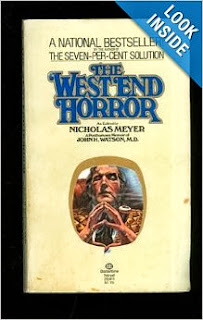
FFB Review: "The West End Horror" by Nicholas Meyer---Reviewed by Patrick Ohl
Friday
means Friday’s Forgotten Books hosted by Patti Abbott here. After recently reviewing The
Julius Caesar Murder Case by Wallace Irwin Patrick Ohl is back today with
his thoughts on THE WEST END HORROR by
Nicolas Meyer. Patrick also has the At
The Scene Of the Crime blog here
so go by there after you read the below review….


It is March 1895 in London and Sherlock Holmes receives a strange visitor at 221B Baker Street. It is a peculiar, arrogant Irishman named George Shaw and he comes to consult Holmes about the murder of theatre critic Jonathan McCarthy. Holmes and Watson accept the case and begin to dig around McCarthy’s personal life, discovering that the man was universally despised in the West End. During their investigations, they run across all sorts of potential suspects, including Oscar Wilde, Bram Stoker, and Sir Arthur Sullivan.
But if only the case had ended there – when
another murder occurs, Holmes and Watson discover something absolutely
horrendous is at the centre of this case, a secret so black it could unravel
the very fabric of British society. In fact, that’s why Watson decided to
entitle this case The West End Horror.
After being lost to the world for years, it fell into the hands of Nicholas
Meyer, who had also edited Watson’s The
Seven-Per-Cent Solution. It is unfortunate, then, that this was such a
sub-par outing for both Holmes and Watson.
I highly enjoyed Meyer’s first contribution
to Sherlockiana, The Seven-Per-Cent
Solution, in which he drastically revised the Canon and played all sorts of
games with historical figures, especially Sigmund Freud. It was interesting, it
was something different, it was fresh. Unfortunately, the same adjectives
cannot be applied to The West End Horror:
it’s a conventional pastiche, and that’s that. It’s no better and no worse than
dozens of other pastiches of its kind. Actually, now that I think of it, it
might even be a bit on the worse side.

You see, it boils down to this: Holmes and
Watson are idiots. This was a weakness in The
Seven-Per-Cent Solution, but because of the book’s other delights as a
pastiche, I was able to ignore it. I have no idea if he’s doing it deliberately
or not, but it would seem that Nicholas Meyer is simply unable of springing a
surprise ending on the reader. Long before Holmes tumbles to the solution, it’s
screaming you in the face, especially after the mysterious actions of a police
coroner are brought into the plot. They’re really not all that mysterious, in
fact it’s rather obvious what the motivation behind these actions was. Not only
that, Holmes wastes a lot of time on really obvious red herrings. Simply put,
it’s remarkable how much time it took Holmes to figure it out. This case is
certainly not among his finest hours.
Although historical figures pop up in The West End Horror, their appearances
seem a lot more perfunctory this time around. Half the time we get heavy-handed
irony from the author about events that will occur in the near future, such as
Oscar Wilde’s infamous tiff with the law, or Sullivan’s death, or Bram Stoker’s
authorial efforts. It even steals words attributed to Winston Churchill at one
point, adding in a footnote that this dialogue has been “misattributed” to him
and it was really Holmes who spoke those words. It’s not as charming or as fun
as it all was with Freud, and it doesn’t really add anything new to the Canon.
Overall, I wish I could show more
enthusiasm for this book, but I just didn’t enjoy myself like I’d hoped. After
the high points of The Seven-Per-Cent
Solution, I was expecting something more inventive, more lively, and more
original than this book. At the end of the day this is a safe, conventional
pastiche that risks nothing and adds nothing notable to the Canon. I can with
clear conscience recommend skipping this one.
Patrick Ohl ©2013
The
nineteen-year-old Patrick Ohl continues to plot to take over the world when he
isn’t writing reviews of books he reads on his blog, At the Scene of the Crime.
In his spare time he conducts genetic experiments in his top-secret laboratory,
hoping to create a creature as terrifying as the Giant Rat of Sumatra in a bid
to take over the world. His hobbies include drinking tea and going outside to
do a barbecue in -10°C weather.
Sunday, October 06, 2013
Sample Sunday: Excerpt from "The Play Of Light And Shadow" by Barry Ergang
Two Sundays ago Barry was in this spot sharing a funny short story from his book PUN-ishing Tales: The Stuff That Groans Are
Made On. If you have not read it yet, you can go here to read it. This week
Barry shared an excerpt from his locked room mystery The Play Of Light And
Shadow. The book has gained very positive reviews including this one here
on the blog “At The Scene Of The Crime.”
THE PLAY OF LIGHT AND SHADOW
by Barry Ergang
On quiet nights Darnell came into
Culhane’s and sat at a table or in a booth.
On busy nights he sat at the end of the bar, as far away from the
traffic as possible. He always had a book
with him, and wherever he sat he’d read, sip Scotch, and smoke. Sometimes he ordered dinner.
Tonight he sat at the bar. After pouring his drink, I glanced at the
book and asked: “What is it this week?”
He turned it over so I could see the
cover: The Sound and the Fury.
“Rereading an old favorite,” he
said.
I raised an eyebrow. “Faulkner.
Pretty unconventional for a private detective.”
He chuckled dryly. “You’re calling me unconventional,
Professor?”
“Good point,” I admitted.


A few months earlier, at the end of
the semester, I had begun a year’s sabbatical from teaching literature at City
University of Philadelphia and taken a job as a bartender at Culhane’s
Pub. The alternative profession, which I
had practiced as a graduate student, gained me unwanted notoriety among the
administration, faculty, and student body, but it got me away from departmental
politics and the hermetic insularity of academia and back into the “real” world
among people with everyday concerns.
Darnell
was a regular customer; literature was our common ground. He wasn’t inclined to small talk, but
discussions about books pierced his reserve and evoked a veiled passion.
A little over six feet tall, with an
athletic build that could run to fat if he weren’t careful, he was in his
mid-forties, with dark, gray-streaked hair and gray-blue eyes in a face of
hard-won stoicism. Deep brackets etched
the corners of his mouth, marking him, you sensed, as witness for half a
lifetime to tragedy and human darkness.
“How’s business?” I asked.
He tapped his book. “Let’s just say I have lots of time to read.”
“Well, I got a call today from
someone who could use a detective.”
“If it’s divorce work, I’m not
interested.”
“It’s more of a security matter.”
He lit a cigarette. “Talk to me, Professor.”
My explanation was fragmented by
customers and waitresses who needed orders filled. Darnell’s prospective client was one of my
university colleagues, Dr. Barton Gaines, Chairman of the Art History
Department. He’d phoned to invite my
wife and me to a party he was throwing the following Saturday afternoon to
celebrate an auction he’d won for a painting by Charles Riveau. My wife works for a large corporation and
would be out of town, but I said I’d be happy to attend. Gaines then voiced his brooding and abiding
concern for the painting’s safety. That
was when I first heard allusions to the shadowy Paul Marchand, Riveau’s nemesis
and Gaines’s hobgoblin—the catalyst for everything that happened later.
Gaines wanted to hire a high-priced
security agency but his wife Marjorie refused.
Hearing this, I said I knew a lone operative whose rates might be more
reasonable and who might agree to the job if he weren’t already engaged by
another client. Gaines had welcomed the
notion.
“Babysitting a painting,” Darnell
said, then shrugged. “Sounds like paid
reading time. Go ahead, set something
up.”
Barry Ergang ©2013
The Play Of Light And Shadow is one of a number of Barry Ergang's books available at Amazon and Smashwords. Barry continues to sell books from his personal library here and has quite a few good ones.
The Play Of Light And Shadow is one of a number of Barry Ergang's books available at Amazon and Smashwords. Barry continues to sell books from his personal library here and has quite a few good ones.
Subscribe to:
Posts (Atom)




 Posts
Posts

