Showing posts with label the golden age. Show all posts
Showing posts with label the golden age. Show all posts
Tuesday, June 25, 2019
Beneath the Stains of Time: The Royal Flush Murders (1948) by Gerald Verner
Beneath the Stains of Time: The Royal Flush Murders (1948) by Gerald Verner: John R.S. Pringle was a veritable one-man factory of crime fiction, who wrote hundreds of novels, short stories and plays, published unde...


Friday, February 15, 2019
Beneath the Stains of Time: The Glass Spear (1950) by S.H. Courtier
Beneath the Stains of Time: The Glass Spear (1950) by S.H. Courtier: During the early days of this blog, I posted an uncommonly short review of a fascinating, imaginative and anthropological mystery novel, ...
Monday, December 17, 2018
Aubrey Hamilton Reviews: The Tipster by Gerald Verner

Gerald Verner (1897-1980) was born John Robert
Stuart Pringle. He also wrote under the names Donald Stuart, Nigel Vane,
Derwent Steele, and Thane Leslie. His literary output was prodigious: More than
120 books, many of which were adapted for films, radio, and stage plays as well
as short stories for mystery fiction magazines.
The
Tipster (Wright & Brown, 1949) is book 10 in Verner’s series
featuring Superintendent Robert Budd of Scotland Yard, Verner’s longest running
series character. Budd finds himself searching for a serial murderer who
announced via an anonymous phone call his intent to kill five people, starting
with Lord Latimer, the Senior Steward of the Jockey Club. (Like Dick
Francis, Verner set many of the Budd books in the world of horse racing.) The recipient of the phone call, the
editor of the Daily Clarion, believes
the call to be a hoax until Lord Latimer is found dead a short time after the
call. Even with the killer’s phone call before each successive attack, Budd is
unable to prevent more deaths.
Budd is reunited
with journalist Gordon Cross and his wife Vicky, who figured in earlier
adventures with Budd. Cross is determined to identify the murderer in order to
ingratiate himself with the editor of the Daily
Clarion to gain a plum job. His headlong pursuit of someone who has already
shown he’s willing to take a human life places both Vicky and himself in
jeopardy more than once.
In classic Golden
Age style Budd and Cross have a nice assortment of suspects to work with. A
likely blackmailer lurks on the edges of the case, providing motivation for
suspicious activity by some of the characters. The first victim’s adopted
daughter had a brother who emigrated to Canada and then disappeared and now
can’t be located. The plot hinges on a turning point that would not hold up
under current forensic techniques, one of the reasons these 1940s stories are
such entertaining reads. Review based on the Endeavour Media ebook.
·
File Size: 2843 KB
·
Print Length: 189 pages
·
Publisher: Endeavour
Media (November 1, 2018)
·
Publication Date: November 1,
2018
·
ASIN: B07K49N61K
Aubrey
Hamilton ©2018
Aubrey
Hamilton is a former librarian who works on Federal It projects by day and
reads mysteries at night.
Monday, November 05, 2018
Aubrey Hamilton Reviews: The Worm of Death by Nicholas Blake
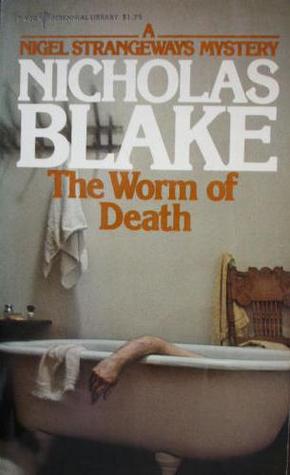
I have taken a break from all of the Bouchercon
thrillers that constituted my reading for a few weeks to go back to the Golden
Age mysteries waiting for me on my TBR stack. This week’s read was The Worm of Death by Nicholas Blake
(Harper, 1961), the 14th title in the Nigel Strangeways series.
Nicholas Blake is the pseudonym of Cecil Day-Lewis (27 April 1904 – 22
May 1972), the UK Poet Laureate from 1951 until his death. His protagonist in
16 of his books is Nigel Strangeways, an upper-class Oxford-educated amateur
investigator in the style of Lord Peter Wimsey or Albert Campion. He is the
nephew of an Assistant Commissioner at Scotland Yard, giving him
status with and access to official crime investigation and law enforcement
groups. This series first began in 1935 and ended in 1966, with a hiatus
during World War II.
In this story, Strangeways and his partner,
sculptor Clare Massinger, have moved into a house in Greenwich. They are
invited to dinner to meet some of their new neighbors, Dr. Piers Loudron and
his family. Rebecca, the only daughter, has become engaged to a man her father
dislikes. The oldest son James followed his father into the practice of
medicine but is overshadowed by his brilliant father. Harold runs a business of
some sort and has married a beautiful woman with roving eyes. Graham, the
youngest, was adopted by Dr. Loudron as a teenager and is openly the doctor’s
favorite, to the resentment of the others.
Nigel and Clare are startled to learn a few days
after their dinner at the Loudron household that Dr. Loudron has disappeared, leaving
his house in the middle of the night during a classic London days-long dense
fog. The diary that the doctor mentioned during their visit is also missing. The
police are called in but no clue to the doctor’s whereabouts is found until
about 10 days later when his body surfaces in the nearby river.
Even though this book was released in 1961, it is
classic Golden Age in every way: The unconventional family with its secrets and
open resentments, the detective who relies on talking to suspects and witnesses
and identifying discrepancies and conflicts in their statements rather than
physical evidence, the law enforcement colleague who provides forensic details,
the atmospheric setting. The river and the people who live on and near it as
well as the ships that frequent it are referenced often throughout and described
in exquisite detail. The writing is beautiful and literate, an absolute
pleasure to read, although the use of dashes in place of curses and epithets
definitely dates it. Highly recommended for anyone interested in classic
detective fiction.
·
Mass Market Paperback: 243 pages
·
Publisher: HarperCollins (paper) (January 1986)
·
Language: English
·
ISBN-10: 0060804009
·
ISBN-13: 978-0060804008
Aubrey
Hamilton ©2018
Aubrey
Hamilton is a former librarian who works on Federal It projects by day and
reads mysteries at night.
Friday, November 10, 2017
New Issue of Crime Review
We feature new 20 reviews in each issue of Crime Review (
www.crimereview.co.uk), together with a top industry interview. This time
it’s author Lynda La Plante in the Countdown hot seat:
http://crimereview.co.uk/page.php/interview/5506

We’re on Twitter at:
Crime Review: @CrimeReviewUK
Linda Wilson: @CrimeReviewer
Sharon Wheeler: @lartonmedia

This week’s reviews are:

THE BALTIMORE BOYS by Joel Dicker, reviewed by John Cleal
Three brilliant young men from different branches of a Jewish family all
have dazzling futures until their close world collapses amid lies, jealousy
and betrayal.

WARLORD by Chris Ryan, reviewed by Linda Wilson
SAS trooper Danny Black leads a covert team with orders to take down a
Mexican drug lord.

PARADISE VALLEY by CJ Box, reviewed by Chris Roberts
Cassie Dewell has spent years tracking a serial killer known as the Lizard
King. An attempt at a trap goes spectacularly awry so Cassie must find
another route to finally bring him down.

THE CONSTANT SOLDIER by William Ryan, reviewed by Arnold Taylor
It is 1944 and Paul Brandt, a German soldier, is returning home from the
Russian front, disfigured and having lost an arm. He has no idea what his
future will be once he has recovered from his injuries.

RESISTANCE by Val McDermid, reviewed by Linda Wilson
When festival goers start falling sick, journalist Zoe Beck sets out to
clear the name of the man whose sausage sandwiches are being blamed for the
outbreak of the mystery disease.

BUTTERFLY ON THE STORM by Walter Lucius, reviewed by Ewa Sherman
A young Afghan boy is found in the woods outside Amsterdam, apparently a
victim of a hit-and-run. Journalist Farah Hafez realises that he speaks her
native language and decides to investigate the events that led to the
accident.

CAMBRIDGE BLACK by Alison Bruce, reviewed by John Cleal
A young woman sets out to prove her father’s innocence of an arson blaze in
which two people died and her inquiries lead DC Gary Goodhew to two more
connected crimes, including the death of his own grandfather.

EYES LIKE MINE by Sheena Kamal, reviewed by Kati Barr-Taylor
A girl is missing. And it’s Nora Watts’ daughter – the one she gave up at
birth.

THREE DAYS AND A LIFE by Pierre Lemaitre, reviewed by Arnold Taylor
Antoine Courtin is 12 years old and lives alone with his divorced mother.
Something of a loner, he has developed a deep love for the neighbours’ dog
and when it is hit by a car and has to be put down he is devastated.

BUFFALO JUMP BLUES by Keith McCafferty, reviewed by Chris Roberts
PI Sean Stranahan is hired by the beautiful Ida Evening Star to find an old
flame who knows something about a small herd of bison that went over a
cliff.

HOFFER by Tim Glencross, reviewed by John Cleal
Suave William Hoffer is a fixer for the super-rich. When a girl is found
murdered in his flat, his past seems to be catching up with him – and he
must revive old instincts to survive.

EXQUISITE by Sarah Stovell, reviewed by Kati Barr-Taylor
What could be wrong with a spark of chemistry between a mentee and her
mentor – other than everything …

THE LEGACY OF THE BONES by Dolores Redondo, reviewed by Chris Roberts
Inspector Amaia Salazar returns to the valley of her birth in Spain to
tackle a chain of murders linked by the severed arms of the victims and the
one-eyed mythical tarttalo.

THE LONG ARM OF THE LAW edited by Martin Edwards, reviewed by John Cleal
CWA chairman Martin Edwards introduces 15 short stories by some of the
great novelists from the golden age of crime writing.

THE BEST KIND OF PEOPLE by Zoe Whittall, reviewed by John Barnbrook
George Woodbury is a respected and much-loved teacher who saved his school
from the attack of a gunman. He is a pillar of the small community of
Avalon until the day he is arrested and accused of inappropriate sexual
behaviour with several of his students.

NEW GUARD by Robert Muchamore, reviewed by Linda Wilson
In one last highly dangerous and highly deniable operation, CHERUB mission
controller James Adams has to plan and execute the rescue of two kidnapped
oil industry workers from war-torn Syria.

THE FORTUNATE BROTHER by Donna Morrissey, reviewed by Chris Roberts
The Now family are crushed by the loss of the eldest son and thrown into
confusion when a local man is killed, a man who nobody had reason to like.

FALSE HEARTS by Laura Lam, reviewed by John Barnbrook
Tila and Taema are sisters who used to be conjoined twins. They moved from
an isolated cult to live in San Francisco, and here they were separated and
given new artificial hearts. Tila is in serious trouble and Taema agrees to
go undercover to save her.

LIGHT TOUCH by Stephen Leather, reviewed by Linda Wilson
Spider Shepherd is sent undercover to report on whether another operative
from a different agency, also working undercover, has gone rogue. In
addition, he’s dragged into the hunt for a possible rogue SAS soldier.

CONTINENTAL CRIMES edited by Martin Edwards, reviewed by Sylvia Wilson
A collection of stories from the golden age of detective fiction, all set
in continental Europe.
Best wishes

Sharon
Friday, September 02, 2016
Beneath the Stains of Time: Stranded in Paradise
Beneath the Stains of Time: Stranded in Paradise: " All evils are to be considered with the good that is in them, and with what worse attended them ." - Robinson Crusoe (Da...
Saturday, March 19, 2016
Beneath the Stains of Time: The Book Case
Beneath the Stains of Time: The Book Case: " But in any case, after another crime, we shall know infinitely more. Crime is terribly revealing. Try and vary your methods as y...
Saturday, December 19, 2015
Beneath the Stains of Time: In a Mound of Trouble
Beneath the Stains of Time: In a Mound of Trouble: "... murder sneaked out and invaded the village, upsetting its routine and disarranging the regularity of its program ." - ...
Friday, May 22, 2015
Friday, April 18, 2014
FFB Review: "FAST ONE" by Paul Cain (Reviewed by Barry Ergang)
Friday means Friday’s
Forgotten Books hosted by Patti Abbott here.
Barry is back today with his review of FAST ONE by Paul Cain.
FAST
ONE (1933) by Paul Cain
reviewed by Barry Ergang
reviewed by Barry Ergang

I can enthusiastically recommend Fast One
to any reader who loves the hardboiled school—especially from the pulp era—but
don’t ask me for a detailed plot summary. That’s next to impossible. Suffice it
to say that a tough character named Gerry Kells, who is visiting L.A. from New
York and who seems to know every major racket boss in southern California, is
in the first chapter framed for a murder he didn’t commit, and who spends the
remainder of the book either dodging or deliberately confronting cops and hoods
with words, fists, and firearms. Along the way he considers trying to take over
L.A.‘s rackets himself.
It’s an aptly titled book because the story roars along at a hectic pace. The pace is aided in no small measure by Cain's staccato prose style, which almost redefines “lean and mean.” But the pace and the story’s complexity are the book’s undoing because there is no characterization for readers to relate to. Most of the players—including the principal female—are referred to only by their last names. The absence of character definition reduces them to mere names on the page. It’s frequently an effort trying to recall from one chapter to another who's who and who's done what to whom.
Fast One has long been hailed as the ne plus ultra of hardboiled gangster tales by the likes of Bill Pronzini, E.R. Hagemann, and Raymond Chandler. David A. Bowman, in his introductory essay to the 1987 Black Lizard edition I have, writes: “Cain took the hardboiled style as far as anyone would want to. Fast One is the Antarctica of hardboiled writing. There is nowhere else to go.”
Forget about any insights into the human condition or any other sorts of profound meanings. Just buckle up and go along on the wild ride.
For more on this novel or the Golden Age of Detection follow the link to the GA Detection wiki. http://gadetection.pbwiki.com/Fast-One
It’s an aptly titled book because the story roars along at a hectic pace. The pace is aided in no small measure by Cain's staccato prose style, which almost redefines “lean and mean.” But the pace and the story’s complexity are the book’s undoing because there is no characterization for readers to relate to. Most of the players—including the principal female—are referred to only by their last names. The absence of character definition reduces them to mere names on the page. It’s frequently an effort trying to recall from one chapter to another who's who and who's done what to whom.
Fast One has long been hailed as the ne plus ultra of hardboiled gangster tales by the likes of Bill Pronzini, E.R. Hagemann, and Raymond Chandler. David A. Bowman, in his introductory essay to the 1987 Black Lizard edition I have, writes: “Cain took the hardboiled style as far as anyone would want to. Fast One is the Antarctica of hardboiled writing. There is nowhere else to go.”
Forget about any insights into the human condition or any other sorts of profound meanings. Just buckle up and go along on the wild ride.
For more on this novel or the Golden Age of Detection follow the link to the GA Detection wiki. http://gadetection.pbwiki.com/Fast-One
Barry Ergang © 2007, 2014
Former Managing Editor of Futures Mystery Anthology
Magazine and First Senior Editor of Mysterical-E, Derringer winner
Barry Ergang's work has appeared in numerous publications, print and
electronic. His website is http://writetrack.yolasite.com/.
Friday, February 21, 2014
FFB Review: "The Corpse in the Car" by John Rhode (Reviewed by Patrick Ohl)
Friday means Friday’s Forgotten Books
with Patti Abbott hosted here later today. Patrick Ohl is back and his obsession
with the Golden Age continues….
Lady Misterton was a general pain in the
derrière to everyone she came into
contact with. But on this occasion, she really crossed the limit. While driving
through Windsor Great Park, she commanded her chauffeur, William Fitchley, to
pull over. She had forgotten her handbag back at her residence, Clandown
Towers. However, she orders the chauffeur to walk the three-and-a-half miles back to fetch the bag. Fitchley
walks off obediently as Lady Misterton sat down and began to knit, while a
portable wireless radio played Saint-Saens’ Danse
Macabre. When Fitchley arrived at Clandown Towers, he found out that Lady
Misterton had taken her bag with her after all…

Furious, Fitchley decides to dally on
the way back and stops at a pub for a “quick one”. Unfortunately, when he
exits, he fails to notice an oncoming vehicle. He is hit and hospitalized… But
what about Lady Misterton?
Unfortunately, the old broa—er, lady, failed to recognize the signs that
she was trapped in a mystery. She was, perhaps, at a slight disadvantage, since
Jonathan Creek was not around yet to
use Danse Macabre as its theme song.
However, that doesn’t change the fact that a few hours later, Lady Misterton
was found dead in her car, and the cause of death cannot be determined. This
forms the plot of John Rhode’s The Corpse
in the Car…
Why yes, the book is an impossible crime
of sorts, as Dr. Lancelot Priestley is called in to determine how an assassin
can strike someone down at will without leaving any traces behind. And what a
job Priestley does! The method employed has a diabolical ingenuity underlying
it, and the doctor does a bang-up job deducing whodunit, how, and constructing
a solid case for the prosecution. Unfortunately, as is often the case with John
Rhode, the murderer’s identity is extremely easy to spot. However, that doesn’t
change the cleverness demonstrated by the rest of the plot, which had me
completely fooled. It also doesn’t hurt that I really like tricks in this
general vein.
However, this book contains more than a
good plot. I venture to say that it is invaluable
for exposing the lie inherent in the idea that Golden Age authors were always
romanticizing the upper class. John Rhode is absolutely relentless towards Lady Misterton. She is a genuinely disturbing
person at times— she professes herself to be a lover of cats. There’s no harm
in that, right? Well… this adoration goes to such lengths that whenever one of
her cats dies, she has it stuffed and added to a macabre collection of stuffed
cats, of which there are 42 (!!!). While alive, she did her best to distance
herself from fellow human beings as much as possible, showing an incredible
snobbery that Rhode certainly does not approve of!
Other upper class characters are
similarly skewered, particularly Lady Misterton’s brother, Mr. Ormskirk. Nastiness
seems to run in the family, as he is only concerned with how he can profit by
his sister’s death… now that she’s dead, that is. While she was alive, he was
only concerned with what a fool she was being, paying attention to a charming
young fellow who professed himself to be a fellow lover of cats. Lady
Misterton’s niece, Emily Higson, is portrayed with sympathy— she married a
clerk in a legal office who isn’t particularly rich, but they have a decent
life together. But Lady Misterton couldn’t stand
him, for the simple reason that he didn’t have money. Lady Misterton was able
to marry into money, why couldn’t her niece do the same thing?
Then there’s the chauffeur Fitchley, who
was hired specifically because his father was a taxidermist and thus, Lady
Misterton could continue having her cats stuffed for a meagre 30 shillings a
week. Fitchley is ruthlessly exploited by Lady Misterton and he is far more
sympathetic— he’s a clever, resourceful fellow who knows how to use his brains.
The only reason he’s stuck in her service is because he was desperate for money
and there isn’t much of a market for taxidermy any more. The character reminds
me of a clever child in Rhode’s Death on Sunday, who is ignored by
his mother and disliked by fellow guests at a residential hotel…. But Rhode’s
sympathies seem to lie with the child, who is the only person there doing
anything really worthwhile!
Overall, John Rhode’s The Corpse in the Car is an excellent
book that showcases Rhode’s storytelling talents very well. The plot moves
along very rapidly and has several intriguing threads chasing each other,
involving the theft of one of the stuffed cats and a potential will that may or
may not be missing (assuming it exists). It’s finely-crafted and shows Dr.
Priestley at his scientific best, not letting a single anomaly get by him
without an explanation. If you’ve never read John Rhode and want a good place
to start, this is it.
Patrick Ohl ©2014
Patrick
Ohl is a 20-year old Canadian crime fiction aficionado who enjoys hobbies such
as taxidermy and runs a dilapidated motel in the middle of nowhere alongside
his crazed mother. He enjoys relaxing in his subterranean evil lair while
watching his favourite hockey team, the Toronto Maple Leafs, and will
occasionally make chicken chow mein to die for. His life is accompanied by a
soundtrack composed by John Williams, and James Earl Jones provides occasional
voice-overs.
Friday, November 29, 2013
FFB Review: "The Rising of the Moon" by Gladys Mitchell--Reviewed by Patrick Ohl
Friday means Friday’s Forgotten
Books with Patti Abbott. The list will
be here later today. In the
meantime, set the leftovers aside and put your hands together for the return of
Patrick Ohl…
Simon and
Keith Innes are two young boys who are supremely excited: the circus is coming
to town! It’s true that the festivities will be taking place on a Good Friday,
but it only comes once a year and it should be taken advantage of. And in
honour of Good Friday, the only reasonable thing to do is to sneak into the
circus without paying!
The action
begins on Holy Thursday, when the boys sneak out of their house to prepare
their route for the following night. But suddenly they see a sinister-looking
figure clutching a knife—a knife that looks rather like the knife owned by
their elder brother, with whom they live… The next day, a grisly discovery is
made—one of the circus people, a tight-rope walker, is found murdered, slashed
to death by a Jack-the-Ripper-like murderer… and the bad news is, this is only
the beginning.


The circus leaves
the town without performing, but soon enough, the villagers cower in fear
whenever the full moon is up… for it is then that the ripper strikes, killing
women and mutilating their bodies. These events are all seen through the eyes
of the two young boys—in particular, the narrator is none other than Simon, and
the story is not so much a mystery as a coming-of-age-story. The two boys are
thrown into the investigation right alongside the local police inspector and
the witch-like Mrs. Bradley, who is sent down to investigate the deaths at the
express wishes of Scotland Yard. She takes rather a liking to the boys. They
deal not only with the murderer, but must also grapple with their mathematics
assignments and they must answer a terribly important question: do Catholics
only need to go to church once a year, and if so, should they convert?
It’s a good
thing that the other elements in this book are so strong, because the mystery
is, to be frank, bloody awful. The murderer instantly became obvious to me on
page 9—and my edition of the book doesn’t start with page 1—it doesn’t even
start with page 5! But it’s not enough that the killer is obvious—oh, no… we
must also endeavour to make the ending as confusing and full of loopholes as
possible! For instance, there’s a scene where the boys finally get to see the
circus. They are told to keep an eye out for this-and-that while there, but of
course they have plenty of fun in the meantime. Then they finally spot
this-and-that, and they give the prearranged signal. What relevance does this
have to the plot? Absolutely none. It’s never referred to again, and in fact,
the ending directly contradicts the idea that this scene ever had any point whatsoever.
As for
logical loopholes, if you want to see psychology at its most gloriously
subjective, look no further than Mrs. Bradley in this book. The police start
with a perfectly reasonable notion of what kind of killer they’re looking for,
but Mrs. Bradley gives a completely different psychological profile. Who’s
right? Why, Mrs. Bradley of course, for the excellent reason that she’s the
detective and therefore can never be wrong. What made the police’s initial
assumption so unreasonable? Well, Mrs. Bradley said otherwise. What was the
significance of the moon? Well… God alone knows. At least I hope so. I wouldn’t
be surprised if God was just as puzzled over this moonshine (pun perfectly
intended).
All this
sounds as though I hate the book… but nothing could be further from the truth.
I have brought up all these problems in the book’s plot because I want to get
these over with before I reach the end of the review—I’d hate to finish on such
a severely negative note! This book is without doubt a masterpiece of writing,
but don’t set the bar high on your mystery expectations.
The book’s
best success is the writing from the POV of a child. It’s got that perfect mix
of childlike innocence and that manner many kids have of wanting to be treated
as grown-up. It all rings perfectly genuine. Simon is a wonderful character,
and we see him forced to grow up with this murder investigation. We also see
the steps he takes to avoid Sunday school and to protect his elder brother when
it seems he might be the murderer. All this is most fascinating, and the
relationship Simon has with Mrs. Bradley has a curious note of poignancy and
tenderness to it. Mrs. Bradley is just as harsh, witch-like, and cackling as
ever, but she teaches Simon a thing or two about life and she’s rather like a
mother-figure to him.
The
atmosphere meanwhile is brilliant. Just… brilliant.
The slowly increasing fear and terror of the villagers… the way the tension is
ratcheted up notch by notch… that final chase in the moonlight… everything adds
up beautifully, and it’s hard to describe the overall effect. I’m at a loss of
words.
So overall, I
tend to agree that The Rising of the Moon
is a masterpiece from the Golden Age of Detective Fiction… but you have to keep
an open mind when the conclusion rolls around, because it is among the most
ridiculous, plot-hole-ridden endings in detective fiction. It’s up to you to
decide how you will take the ending. Maybe you will decide, as I did, that it
doesn’t affect the quality of the book enough to lower it. Maybe you will
decide to write your local Member of Parliament to protest. (It's not like
they're doing anything important.) But if you’re willing to swallow the
ending, you will see that the book is a very worthwhile experience!
Patrick Ohl ©2013
Patrick
Ohl is a 20-year old Canadian crime fiction aficionado who enjoys hobbies such
as taxidermy and runs a dilapidated motel in the middle of nowhere alongside
his crazed mother. He enjoys relaxing in his subterranean evil lair while
watching his favourite hockey team, the Toronto Maple Leafs, and will
occasionally make chicken chow mein to die for. His life is accompanied by a
soundtrack composed by John Williams, and James Earl Jones provides occasional
voice-overs.
Friday, September 20, 2013
Double Take FFB Review: "THE CASE OF THE BAKER STREET IRREGULARS" by Anthony Boucher
Friday
means Friday’s Forgotten Books hosted by Patti Abbott here.
Having offered their double take reviews of THE GREAT MERLINI: The Complete Stories of the Magician Detective by
Clayton Rawson and Richard S. Prather’s Strip for Murder in recent weeks, they decided that The
Case of the Baker Street Irregulars by Anthony Boucher should
be covered this week. Believing youth always goes first, Patrick is up first, and then Barry……
Anthony Boucher’s The Case of the Baker Street Irregulars is a delightful book full
of wit and humour… but at the same time it is an incredibly frustrating book. Boucher, a prolific author, critic,
and editor, was also a big Sherlockian and this really shows in this book,
which I own in a highly attractive Gregg Press edition. Although it does not
star his usual detective, Fergus O’Breen, it does connect to O’Breen in that his sister is a major character, as
well as a police officer who appeared in The
Case of the Seven of Cavalry.
When F. X. Weinberg of Metropolis
Pictures set out to adapt the Sherlock Holmes story The Speckled Band into a film, the reception was initially
enthusiastic. After all, it is a great story for adaptation, as Conan Doyle
himself said. Unfortunately, Sherlockians everywhere suddenly turned against
Weinberg when he hired the hated Stephen Worth to write the screenplay.
Nobody worse could have possibly been
chosen for the job (with the possible exceptions of Michael Bay, who wasn’t
around yet, and/or Raymond Chandler). Stephen Worth has expressed absolute hatred
of Holmes and his stories, and he vows with his screenplay that he will
“toughen up” the Great Detective and show his lily-livered followers just what
a real detective does. As the author
of several hardboiled detective novels and an ex-private eye himself, Worth
seems like the ideal choice to butcher the source material.
Suddenly, F. X. Weinberg finds himself
branded Public Enemy No. 1, and when he tries to get rid of Worth, the
screenwriter points out a clause that says that if he doesn’t write the script, nobody will. Finally, to appease the
Baker Street Irregulars, F. X. Weinberg invites a delegation to come to
Hollywood to serve as unpaid consultants. The invitees eagerly accept, and the
stage is set for murder: for not long after he crashes the welcoming party,
Stephen Worth is found shot. But then his corpse disappears and the Baker
Street Irregulars all find themselves involved in adventures that could have
come straight from Conan Doyle’s pen… This sounds like a job for Sherlock
Holmes himself! But since he isn’t around, the Baker Street Irregulars will
have to do.
This book is truly a delightful read for
the Holmes fan. You will find all sorts of great references to the Canon, such
as a police officer named Sergeant Watson who must guard over the house in
which the Irregulars are staying. And the next day when their adventures take
place, they all have multiple connections to the Holmes Canon and the untold
stories Watson alluded to, such as the adventure of the tired captain or that
of Colonel Warburton’s madness. These are witty and wonderful, and they form
the most delightful part of the book.
Unfortunately, as delightful as the book
is, it quite simply falls apart by the ending. This is a book that logically
makes little sense. There’s a huge
paradox that you simply cannot ignore
about Stephen Worth— and as much as you try to forget this gaping hole, the
book won’t let you forget it, making it an integral part of the solution.
There’s no reason why half the people involved should have acted the way they
did. There are inexplicable masquerades that are apparently orchestrated by the
same person even though multiple ones take place at the exact same time in
different parts of town... There’s the ever-so-convenient aspect of motive,
which brings up an entirely new plot hole: how the devil could P.I. Stephen
Worth uncover dirty secrets, but these same secrets eluded the efforts of the
entire LAPD???
And yet, not even this lack of logic
makes for a surprising solution. Half of the ‘twists’ are painfully obvious despite the fact that a sieve holds more
water than these revelations. You get sudden, dramatic reversals of character,
and a killer who could have very well been anybody else with just a bit of
tweaking. That’s not a sign of a strong detective novel.
The book’s saving grace, then, is its
wit and the charm of all the Sherlockian references. As much as I enjoyed The Case of the Baker Street Irregulars,
I had to swallow a very convoluted and fundamentally flawed mystery. While it’s
a fun book, it’s of far more interest to the Sherlockian than to the casual
mystery fan. If you absolutely love Sherlock Holmes, you will probably enjoy
this book for the Sherlockian references. But if, like Worth, you can’t stand
the fellow, or even if you are casually indifferent, your reaction could end up
being very different.
The reader is warned.
Patrick
Ohl ©2013
The
nineteen-year-old Patrick Ohl continues to plot to take over the world when he
isn’t writing reviews of books he reads on his blog, At the
Scene of the Crime. In his spare time he conducts genetic experiments
in his top-secret laboratory, hoping to create a creature as terrifying as the
Giant Rat of Sumatra in a bid to take over the world. His hobbies include
drinking tea and going outside to do a barbecue in -10°C weather.

THE CASE OF THE BAKER STREET IRREGULARS (1940) by Anthony Boucher
Reviewed by Barry Ergang
Mystery lovers who haven't
read it will probably find The Case of the Baker Street Irregulars by
Anthony Boucher a lot of fun. It combines bizarre situations, action, humor,
lively and intelligent prose, and the advancement of several plausible
solutions before the actual one is revealed.
Stephen Worth, ex-private
detective turned hardboiled mystery novelist and sometime screenwriter under
contract to Metropolis Pictures, is supposed to write a screen adaptation of
“The Adventure of the Speckled Band,” which will be produced by F.X. Weinberg.
When word of this makes the newspapers, Weinberg starts receiving irate letters
from the Baker Street Irregulars. The want the screenplay entrusted to someone
who reveres the Canon as they do, not a “rat,” as they refer to Worth, who
writes hardboiled fare. For his part, Worth contemptuously dismisses the BSI as
a bunch of “deductionists.” The studio's publicity director, Maureen O'Breen,
who has no liking for Worth, a heavy-drinking lecher and prankster, suggests
that Weinberg simply take him off the film and assign another writer. When
Weinberg tries to persuade Worth to work on a different project, Worth balks at
the idea and points to a contractual clause that effectively prevents him from
being replaced involuntarily. From his position between rock and hard place,
Weinberg hits on a solution and sends letters to each of the five Irregulars
who have written to him, inviting them to Hollywood at his expense to serve as
advisors on the film. When they agree, the studio provides a house for them at
221B Romualdo Drive, complete with a housekeeper named Mrs. Hudson.
To help tout the film, Maureen
plans a party for the press. On the afternoon of the party, Maureen, trying to
coordinate the preparations at 221B, is besieged by mysterious callers,
messages, and telephone calls. Once things are under way, Stephen Worth makes a
drunken, belligerent appearance. When he tries to hit one of the Irregulars,
his wild swing hits instead one of the guests, Lieutenant Jackson of the police
department. Jackson knocks him cold and he and some others carry Worth to a
room upstairs to sleep it off. That ends the party. Later on, Maureen goes
upstairs and finds a still drunk and abusive Worth standing in the doorway of
the room. Moments later she hears a shot, blood blossoms under the hand Worth
claps to his heart, and he falls back into the darkened room. When she bends to
help him, something strikes the back of her head, rendering her unconscious.
One of the Sherlockians carries her downstairs. When she revives and reports
what's happened, Lieutenant Jackson goes to investigate.
There's a lot of blood in the
room. There are other significant things there, too. There just isn't any
corpse. The next day, each of the Irregulars has a peculiar, sometimes
frightening adventure. Each adventure has its roots in a Holmes story, and each
elicits information about another Irregular which he'd prefer not be revealed.
The police and the Sherlockians thus have their hands full trying to unravel
codes and ciphers, interpret the meaning of the adventures, and discover the
whereabouts of Worth's body and the means by which it was removed from the
house. There's a cover blurb from the New York Times Book Review on the
paperback edition I have which reads, “Delightful...offers a surprise on nearly
every page.”
This brings me to the only
complaint I have about the book—the edition. Mine was published by Carroll
& Graf. I'm not sure about the number of pages containing surprises, but
this particular book must have been proofread by someone whose idea of
intellectual activity is dwarf-tossing. Even by C&G standards, which
generally seem to be abysmal in the typographical error department, this one
qualifies for the Guinness Book of World Records. By all means read the
book. Just avoid the Carroll & Graf edition if you have options.
Barry Ergang © 2003, 2007,
2013
Among other works, Derringer Award-winner Barry
Ergang's own impossible crime novelette, "The Play of Light and
Shadow," is available at Amazon
and Smashwords. Barry is selling
books from his extensive personal collection at http://www.barryergangbooksforsale.yolasite.com/
Friday, July 26, 2013
FFB Review: "The Long Goodbye" by Raymond Chandler
Friday means Friday’s Forgotten Books. Please welcome back Barry Ergang and make
sure you check out the other reading possibilities here after you read the review
below……
THE
LONG GOODBYE by Raymond Chandler
Reviewed
by Barry Ergang
Mark Twain defined a classic as “a book which people praise and don't read.” The point is well-made, although Twain was fortunately wrong. People still read Huckleberry Finn, Tom Sawyer, A Connecticut Yankee in King Arthur's Court, and The Prince and the Pauper.

They still read Raymond Chandler, too. Chandler, along with Dashiell Hammett and Ross Macdonald, is the chronological second in the Supreme Triumvirate of the “hardboiled” school of mystery writing. All three worked in what was long considered a second-rate genre and elevated it to the status of “serious literature.” Chandler garnered accolades from, among others, cantankerous critic Edmund Wilson and poet W.H. Auden. In his first five novels, Chandler worked within the traditions of the genre but added his own distinctive touches. These included character development well beyond that found in the work of most of his peers and a writing style that was among the most influential of the Twentieth Century. Critics have called Chandler's style “the poetry of violence,” and Chandler “the hardboiled Shakespeare.”
Wisecracks and wry social commentary came from Philip Marlowe, the cynical but never quite despairing shamus with the unstated but steadfast code of honor and incorruptible character in a morally ambiguous world where chivalrous behavior no longer matters, whose brisk, simile-laden first-person narratives set the tone for generations of Chandler's/Marlowe's followers. (The best include Earl Emerson's Thomas Black and Stephen Greenleaf's John Marshall Tanner. The worst is the pretentious Robert B. Parker's Spenser, the Philip Marlowe wannabe with the New England pallor.) Marlowe was not the first private eye in literature, but he became the quintessential one. In his sixth book, The Long Goodbye, Chandler pushed beyond the boundaries of genre conventions. More than either his predecessor Hammett or his successor Macdonald, Chandler succeeded in blending elements of the hardboiled detective story with elements of the mainstream novel. The reader who approaches The Long Goodbye expecting lots of slugfests and gunplay will be disappointed.

When, very early one morning, Lennox shows up at Marlowe's home, demanding the detective drive him to a Tijuana airport, Marlowe agrees to play chauffeur. He knows intuitively that Sylvia is dead, but his instincts tell him Lennox is not her killer. Returning to L.A., Marlowe is arrested on suspicion of murder, assaulted by the police, and jailed for several days. When word comes from Mexico that Lennox committed suicide and left a confession, Marlowe is released, disbelieving the confession based on his knowledge of Lennox. As he remarks, “A dead man is the best fall guy in the world. He never talks back.” The next day, Marlowe gets a visit--and a warning--from a powerful local hood named Menendez, who tells him to forget the Lennox case. Menendez, Lennox, and Las Vegas-based hood Randy Starr were in the Commandos together during WWII and Lennox saved their lives. Menendez resents that Lennox, when in trouble, sought Marlowe's help rather than his and Starr's. It also becomes increasingly clear that details of the case have been quashed by Lennox's influential multimillionaire father-in-law, who values his and his family`s privacy above all else.

Soon afterward, Marlowe is consulted by a New York publisher who wants him to babysit a bestselling historical novelist named Roger Wade. Wade, an alcoholic, has been unable to finish his latest novel, and the publisher wants Marlowe to keep him off the booze and at the typewriter. Marlowe refuses the job as an impossibility, but when Wade suddenly disappears, he's hired by the writer's beautiful wife Eileen. When Marlowe finds him and brings him home, he becomes almost inextricably involved with the Wades' tormented lives. The seemingly disparate plotlines eventually converge, other deaths occur, and Marlowe solves two murders--with some undesirable surprises. All of this sounds like standard mystery-novel fare. What sets it apart from the run-of-the-mill are Marlowe's and other's comments about society, crime and criminals, wealth, and power; the interplay among the well-defined characters; strongly visualized scenes; and the motifs: pride; honor; the abuse of official or private power; and the traps we set for ourselves.
Why review a well-known novel originally published in 1954? I recently reread it for the sixth time, rediscovering again Chandler's virile prose-poetry, irresistible storytelling abilities, and timeless observations. I thought it appropriate to recommend The Long Goodbye to readers who have not yet come to it, and to remind those who have that it is eminently worth reading again. To those who have only ever seen Robert Altman's feebly inaccurate film adaptation: read the book! With all due respect to Mark Twain, not all classics are ignored.
(A shorter version of this review originally appeared in
Maelstrom, Volume IV, Issue 3, 2003)
Barry Ergang © 2003, 2007, 2013
Friday, March 15, 2013
FFB Review: "The Broken Face Murders" --Reviewed by Patrick Ohl
This
is Friday and that means Friday’s Forgotten Books. Patrick Ohl returns today
and the rest of the suggestions can be found over at Patti’s blog.
Darwin and Hildegarde Teilhet were British
authors who sometimes worked together but sometimes worked separately. I really
can’t say much more about them. Teilhet is known among Golden Age enthusiasts
as the author of The Talking Sparrow
Murders (which I’ve yet to read). Although written in 1934, it had a strong
and unrepentant anti-Nazi stance, at a time when the Nazis’ rise to power
didn’t seem like an extraordinary issue. After all, Germany had been so
unstable it seemed like Hitler was just the latest in a long string of leaders.


But when 1940 rolled along, times obviously
changed— in September of 1939, Hitler precipitated World War II by invading
Poland, and before you knew it, all of Europe was engaged in warfare. And it
was in 1940 that Darwin and Hildegarde Teilhet released The Broken Face Murders, being the fourth adventure of the Baron Franz
von Kaz, a comic detective in the tradition of John Dickson Carr’s Sir Henry
Merrivale.
Only the Baron’s adventure is hardly a
comic one. Perhaps it was just in this book, but this is a dark and sombre
tale, with plenty of greed, corruption, and racism. The Baron von Kaz gets
married to Caryl Miquet (a presumably recurring character), to kick the book
off with a bang. They then get in a car and head to Los Corrales, where they’ve
signed a lease for two years on a lovely “dream home”, complete with ten acres
of land. And it’s unbelievably cheap, too— the Baron managed to get it from the
owner, Mr. Gulthwort, for a mere $100 a month.
Now, I know there’s been a lot of inflation
since the 1940s, but even for that time, $100 monthly for such a property is a
staggeringly small amount. And the Baron von Kaz finds out that there is indeed
a catch when Mr. Gulthwort stumbles in on him and Caryl as they prepared to
spend the night together. Gulthwort gets talking to the Baron alone, and starts
to babble about how he’s got the baron in a corner, that the baron simply must
help him now, and that his enemies will never find out from him what the
“broken face” is.
Caryl, meanwhile, is not happy at being
left alone upstairs. She calls the Baron upstairs and demands that he force their
late-night visitor to leave. So the Baron, full of resolve, comes lumbering
downstairs. But a grisly sight awaits him—Mr. Gulthwort is lying slumped in his
chair, a hole in his head caused by impalement on a paper file. Suddenly, a gun
is jammed in the Baron’s back, and the assailant demands to know the location
of the broken face. He seems disinclined to believe the Baron’s protestations
that he really doesn’t know where the broken face is…
Enter Caryl Miquet, who has grabbed her
husband’s gun and come downstairs. She fires two shots, and by sheer mischance,
one of them manages to lodge itself in the dead man’s head, obliterating the
traces of the paper file. When the cops arrive, they decide that Caryl shot Mr.
Gulthwort and the Baron made up a fairy story to cover it all up. They take her
away… and that’s just the first two chapters.
The rest of the story is an extremely
complex one but with simple ideas at heart. Basically, this is an investigation
in the Phillip Marlowe routine— there’s a lot of emphasis placed on corruption
in politics, in the police force, and anti-Semitism. The Baron gets in a few
fights that Phillip Marlowe would have been proud to partake in, but it seems
somewhat odd to see him in the melee. It seems that the mayor of Los Corrales
and the head of police are somehow in cahoots with one another. They seem
anxious to cover up the crimes, and all this seems to tie up with the death of
the previous mayor, supposedly by accident.
The tale is dark and unrelenting— in one of
the opening chapters, the murderer even kills a dog that may have recognized
him. It’s a chilling moment. Other moments, such as a confrontation in the
mayor’s house full of veiled threats, are equally disturbing. So when the comic
relief comes, it feels like a desperately needed source of relief. These scenes
of comic relief are often rather brief, but quite funny. One of the best is
when the Baron gets information out of an uncooperative shopkeeper by
threatening property damage. Another very funny moment is when the Baron
eagerly destroys a priceless painting looking for a hidden message, and decides
that his “altered” version is undoubtedly a major improvement.
And yet, as appreciated as these moments
are, they do seem somewhat out of place in this story. Its dark and unrelenting
nature does not make it an unequivocally fun read, and at 300 pages, it
sometimes feels quite padded. There are also uncomfortable parallels with
Hitler’s rise to power, as we see the mayor is head of a very similar
organization that absolutely hates Jews. The Baron, who is sympathetic to the
Jewish cause under Nazi oppression, is not an entirely welcome guest as a
result.
The “broken face” is a clever plot device,
and its ultimate location has a perverse sort of simplicity behind it. However,
it succeeds only in making the Baron von Kaz and the police officers look like
complete morons for having overlooked it, and it seems like an unnecessary
moment. Even the Baron seems to consider it a futile discovery, for reasons he
analyzes in the finale. Nevertheless, the ending is excellent, with a very
suspenseful and skilfully-written shootout followed by a memorable scene
between the Baron and... oh, maybe I’d better not say who.
Despite some reservations, I’d recommend The Broken Face Murders. It isn’t an
unheralded classic in the genre, but it is undoubtedly worth a look for its
scathing portrait of anti-Semitism and, in some ways, American society.
Patrick Ohl ©2011, 2013
The
nineteen-year-old Patrick Ohl writes reviews of the books he reads on his
blog, At the Scene of the Crime.
In his spare time he plots a takeover of the world, being careful to factor
everything except for Bruce Willis into his equations.
Friday, January 25, 2013
FFB Review: "The Case With Nine Solutions"
In addition to cardiac surgery for Sandi this morning, Friday means Friday's Forgotten Books. Please welcome back Patrick Ohl to the blog. For the complete
list of books, authors, and reviewers, please surf over to Patti Abbott's
excellent blog........
Most men, they'll tell you a story straight
through. It won't be complicated, but it won't be interesting either.
—Ed Bloom, Big Fish (2003)
Alfred Walter Stewart had a long career as a
professor in chemistry and a university lecturer in Glasgow and Belfast, but
more importantly for the purpose of this review, he also wrote detective novels
under the name “J. J. Connington”. He was a well-regarded figure in his day,
and John Dickson Carr gave him some praise in his famous essay The Grandest Game in the World. One of
Dorothy L. Sayers’ better novels, The
Five Red Herrings, is in part an homage to his book The Two Ticket Puzzle.
Unfortunately, academic disinterest and snobbery
levelled against the Golden Age of Detective Fiction have seriously harmed
Connington’s reputation. If you hear about him at all nowadays, it will be
classed alongside the similarly-maligned John Rhode, Freeman Wills Crofts,
Henry Wade, or R. Austin Freeman. (None of these writers were mentioned by P.
D. James in Talking About Detective
Fiction, and Julian Symons mentions some of these authors only in passing.)
He will be called an ingenious technical writer but someone who couldn’t
entertain a drunken fish— a Humdrum, in other words. After reading his book The Case With Nine Solutions, I can
propose two explanations to explain this nonsense. Either Connington and his
fellow Humdrums have been unfairly attacked, or I need to start hanging around drunken
fish more often.
The first explanation seems more likely, because
unlike, say, Freeman Wills Crofts, Connington succeeds admirably in bringing
his characters to life and making them seem like real people with real emotions.
Not only that, he manages to throw in social commentary that would confound
anti-Golden Age snobs if they bothered to read his books, and he combines it
with a brilliantly-clued puzzle and some small asides about chemistry that make
me wish he was my lecturer in university.
But I’m really getting ahead of myself here. Let’s
tackle the plot first and foremost. Dr. Ringwood is sitting comfortably at home
when a colleague, Dr. Trevor Markfield, drops in to visit. The social call is
short-lived, however, as the maid of the SIlverdales telephones: a fellow maid
is seriously ill and she requires Dr. Ringwood’s help. The fog outside is
intense, so Dr. Markfield kindly offers to pilot Ringwood to the correct
street, but Ringwood manages to get muddled up and drives up to the wrong
house. He enters, suspecting something is amiss, and inside, he finds a young
man who has been shot twice in the lung. He spurts out a mysterious cryptic
dying message and expires.
There’s no phone in the house, so Dr. Ringwood goes
next door, to the correct house this time, and diagnoses a case of scarletina
before calling up Sir Clinton Driffield to ask for help. He decides to wait at
the house, since he can do nothing for the ill maid, and when the police
arrives, Sir Clinton makes some excellent deductions to prove that the murder
took place elsewhere. They then head to the Silverdale residence, but nobody
answers the doorbell. This is because the maid has been strangled in the
interim, and the other girl has only escaped with her life due to her illness…
Thus begins a hunt for a particularly unlikeable
killer, who seems to have murdered three people when the corpse of Mrs.
Silverdale is discovered. The dead man next door turns out to be her potential
lover, Hassendean, and he seems to have been universally disliked: a nasty bit
of goods whose only advantage in life was his connections. But is this a case
of double murder? An accident? A suicide pact gone wrong? What are the titular
nine solutions?
Well, The
Case With Nine Solutions is an impressive title, but a more appropriate one
might be The Case With Nine Possibilities.
This is because the book focuses on the deaths of Mrs. Silverdale and
Hassendean, and the nine solutions are the nine possible combinations when you
consider that every unnatural death must be the result of accident, suicide, or
murder (unless you’re in a John Rhode novel, but that’s a discussion for
another day). This is the only thing that comes close to a disappointment in
the entire book— everything else weaves itself into a complex web of
cryptograms, anonymous messages, footprints in the soil, alibis, deceptions,
love affairs, and disguises. The solution turns out to be a simple one, and the
final chapter consists of entries in Sir Clinton’s notebook, with some clues so
ingenious I never spotted them, and my jaw dropped in surprise and admiration
when I read the clue that was the key to Mrs. Silverdale’s death. The solution
is not mind-blowingly original – the publisher is not the killer, if that’s
what you were betting on— but it’s excellently constructed. The clues slip
right under your nose.
Sir Clinton’s deductions are truly admirable— take
note in particular of his opening scene, where he deduces just why Hassendean
was murdered elsewhere, and the reconstruction of the maid’s murder in Chapter
4 is a particularly impressive passage. (It’s little wonder Carr thought highly
of Connington’s work— you can see some influence on Carr’s own work,
particularly the impressive reconstructions of Dr. Gideon Fell.)
So the plot is a triumph, and that makes the
engaging characters and social commentary interesting extras to an already
superb book. Golden Age authors are much maligned for not striving towards
literary ends, and Connington indirectly thows his two cents into the argument
early on:
All three of them were experts in death, and among them there was no
need to waste time in polite lamentations. None of them had ever set eyes on
the victim before that night, and there was no object in becoming sentimental
over him.
Critics like P. D. James love taking authors to
task for their supposed upper-class worship— you’d get the idea that every
amateur detective was a Philo Vance or Lord Peter Wimsey clone! But this is an
outrageous lie invented by people who have no idea what they’re talking about—take
a look at this unflattering portrait of an upper class character, an
influential relative of the dead man:
Dr. Ringwood, watching the change in the situation, reflected
sardonically to himself that a title had its uses when one came to deal with a
snob.
“That old bounder was rude to the Inspector on principle; but when Sir
Clinton Driffield asks precisely the same question, he’s quite amenable,” he
thought to himself. “What a type!”
If that wasn’t enough, you even get some social
commentary in the opening pages, after Dr. Ringwood complains at length about
the difficult life of a medical practitioner:
“Still got the notion that human life’s valuable? The war knocked that
on the head,” Markfield commented, rubbing his hands together to warm them.
“Human life’s the cheapest thing there is. It’s a blessing I went over to the
scientific side, instead of going in for physicking. I’d never have acquired a
good sympathetic bedside manner.”
And then there are some great side-lectures on
chemistry, which are interesting, clearly explained, and not too long. In
Chapter 8, for instance, Sir Clinton lectures about the purpose of taking a
mixed-melting point. It is an informative and clearly-worded passage, and I
just love asides like this from people who knew what they were talking about.
Connington wasn’t some fellow who pulled the first complex-sounding term out of
a chemistry textbook to artificially inflate his level of intelligence—he was a
lecturer in the subject and dealt with this kind of stuff daily. When these
explanations are given, they sound like a professor is having a one-on-one with
a student who’s having trouble understanding the course material.
Overall, The
Case With Nine Solutions is a triumph, and I’d argue a masterpiece in the
genre. Connington keeps a firm grasp on all his plot threads and the resolution
is most satisfactory. It’s a must-read for fans of the Golden Age of Detective
Fiction, and it’s a good book from an unfairly maligned author. It shows creativity
in its set-up and pure ingenuity with its clues, and that’s a quality that
can’t be scientifically quantified. An author either has that magic or hasn’t
got it— and Connington puts on a grand performance that proves he’s definitely
got it. It’s combined with skilful writing that makes this an unadulterated
pleasure to read. I highly recommend it.
But where can you find this masterpiece? The good
folks at The Murder Room have got you covered. A Kindle edition of the book has
been released, and it is a bargain, especially when you consider how much
sellers ask for copies of the old hardcover. You can find the Kindle edition here.
For a list of the currently available books by Connington (more are apparently
due in February if The Book Depository is to be believed) visit The Murder Room’s website.
Patrick Ohl ©2013
The 19-year-old Patrick Ohl spends his spare time
writing controversial reviews in order to expel his bitterness at the world.
For this reason, he was awarded a multimillion dollar contract to publish his
memoirs, entitled I Can’t Stand Postmodernism. Unfortunately, after signing on the
dotted line, he woke up and has been unable to return to the dream since to see
if the book was a success. However, that doesn’t faze him, and he still intends
to make millions of dollars and use his international fame and influence to
bring some well-deserved attention to forgotten authors like this one. His
reviews can be found on his blog, At the Scene of
the Crime.
Subscribe to:
Posts (Atom)




 Posts
Posts

